a free guide
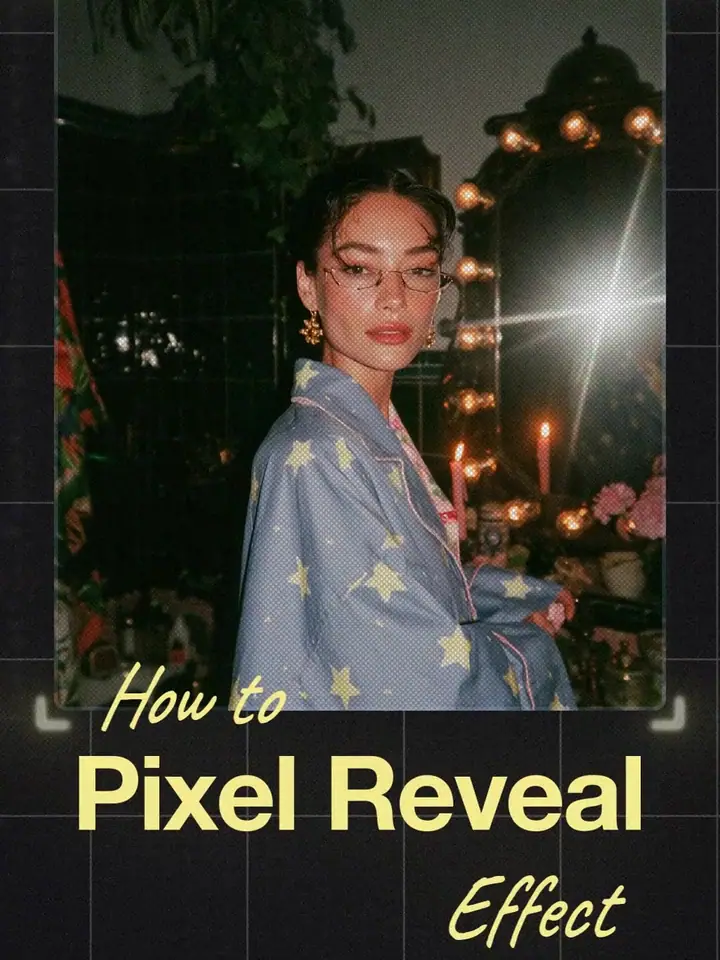
Pixel Reveal effect: the free skill for Chat GPT or Claude
Upload your pictures, paste one prompt, get the pixel reveal video.
Scroll down for the prompt 👇
5 simple steps
What you’ll get
- The pixel reveal video from the reel, made from your own pictures
- One prompt to copy, with the full script inside
- Soft sounds and a 1080x1920 mp4 that is ready to post
0 of 5 doneNow: Open Claude or Chat GPT
Open Claude or Chat GPT
Use a chat that can run code. Claude with code execution or Claude Code works best.
Upload 2 to 6 pictures or short clips
Pictures and short clips both work.
Copy the prompt and paste it
Paste the prompt below into the chat. Add your own titles if you want: "small line | BIG line | small line" for each picture.
Prompt 1 of 1: Pixel Reveal# PIXEL REVEAL video effect You are making a short vertical video from the files I uploaded (pictures and/or short video clips). Follow these steps exactly. Write code and run it yourself; give me a finished mp4, not instructions. ## What the video looks like - **Stage:** dark background `#1A191C` with a grey grid (`#545458`, big squares 235 px, faint small squares 29 px), fine halftone print dots, light film grain, soft vignette. The camera is never still: the grid slides up 130 px in the first second, then the view slowly pulls back (grid to 90 %, picture card to 84 %, so the two layers move apart = parallax) and keeps drifting very slowly. - **Picture card:** 918 x 1113 px, rounded corners (radius 18 px), centred, top at about y 190. Thin light-blue rim `#A5CDFF` and a faint blue "glass echo" 7 px up-right behind it. Pictures are cropped to fill the card. A video clip keeps playing inside its card (it loops). - **First reveal (0.2 to 1.0 s):** the card rises 320 px into place while the picture appears from bottom to top through a **mosaic matte**: 58 x 58 blocks, hard edges, with a jagged edge of loose blocks. A short warm glow sits around the first strip. - **Title, yellow `#F4EA8E`, three lines:** a small script line that overlaps the card's bottom-left corner, a big bold line as wide as the card, a small script line right-aligned below. Each line rises fast, starts as a grey blur inside a wide soft olive-yellow glow (`#767C34`) with a pale rim (`#FFF6A8`) around the letters, then **snaps sharp** in one step and turns yellow. Every picture has its own title: the old one blurs away when a transition starts, the new one glows in at 45 % of the transition. - **Transitions between pictures**, in this order, repeating: **ring closing** (new picture grows in from the corners and closes on the old subject), **block wipe** bottom to top, **ring opening** (from the new subject outwards), ring closing. They use **big cubes: 32 across the card** (about 29 x 35 px). Cubes flip **one by one in scattered order** near the moving edge, never as a clean line. Each cube **lights up for a split second in its OWN brighter, richer colour** (never white, never grey) and fades over 4 ticks (about 0.13 s), with a small glow of the same colour. - **Speed:** each transition takes 38 ticks = 76 frames = about 1.3 s, then the picture holds about 0.45 s (14 ticks) before the next one starts. Slow enough to read every title. - **End:** a short flash to white, then the empty stage (or `--end hold` to stay on the last picture). - **Sound (optional, on by default):** soft bell notes and tiny ticks made in code, one on every event (blocks climbing, title snap, each transition, flash). C major pentatonic, no music. - **Output:** 1080 x 1920, 60 fps, H.264 mp4 (yuv420p). Length: 1 picture = 4.1 s, 2 pictures = 3.7 s, every extra picture adds 1.73 s (5 pictures = 8.9 s). ## The maths (already in the script; keep it if you change anything) - Time unit: 1 tick = 1/30 s. Tables of keyframes are in ticks. - Mosaic matte, per block: `v = ramp + amp * (noise - 0.5)`; the block is visible when `v < threshold`, and the threshold moves with the progress. Up-scale blocks to pixels with nearest neighbour (hard edges). - First reveal: `ramp` = 0 at the bottom row, 1 at the top row; 58 blocks; `amp` 0.20; `noise` = white noise mixed with sideways clumps. - Block wipe: same ramp, 32 cubes, `amp` 0.08, plain white noise per cube (this gives the scattered flip order), smoothstep progress. - Rings: `ramp` = distance from the subject's centre (in card widths) + `amp * (noise - 0.5)`, compared with a radius that shrinks (closing, table `RING`, 0.80 to 0) or grows (opening, ease-out power 1.8). - Cube shine: build the same mask for 8 earlier moments (0.5 to 4 ticks back). `age = mean of those masks`. `glow = mask * (1 - age)^1.5 * strength_of_this_cube` (random 0.3 to 1.0 per cube) `* 0.85`. Lit colour = `colour * (1 + 1.9 * glow) + 14 * glow`, scaled down so the largest channel stays under 250 (this keeps the hue), then saturation x `(1 + 0.45 * glow)`, plus a blurred copy (sigma 10 px) x 0.55 as glow. - Title glow: haze = (blur 93 px x 5.2 + blur 33 px x 1.3) of the text, added in olive-yellow; rim = blur about 7 to 14 px x 1.7 minus the text body; body = text blurred 15 px to 0. The blur, haze and rim all drop to zero at tick 8 of the title (the snap). ## Steps 1. **Inputs.** Use every file I uploaded, in upload order (or file-name order). Do not ask me questions if you can avoid it. Ask only if there is no picture or clip at all. If a file is HEIC/WEBP or another format Pillow cannot open, convert it to PNG/JPG first. 2. **Titles.** If I gave titles, use them. If not, look at each picture (or the first frame of each clip) and invent a short 3-line title for it: small line (1 to 2 words) | BIG line (1 to 2 words, at most about 12 letters) | small line (1 to 2 words). Example: `Open late|Night Store|24 / 7`. If you cannot look at the pictures, build the titles from the file names. 3. **Subject centre.** For each picture estimate where the main subject is, as `x,y` from 0 to 1 (0,0 = top-left). The rings close and open there. If unsure use `0.5,0.45`. 4. **Save the script below** as `pixel_reveal.py`, exactly as written. Do not rewrite it or "simplify" it. It needs only Python 3.9+, numpy and Pillow, runs on CPU with no internet and finds fonts by itself (a handwriting or italic font for the script lines, a bold sans such as DejaVu Sans Bold for the big line; pass `--font-bold` / `--font-script` with a .ttf path to choose your own). 5. **Encoder.** The script uses `ffmpeg` if it is on PATH. If it is not, try `pip install imageio-ffmpeg` (the script picks it up). If that is not possible either, it falls back to OpenCV (`cv2.VideoWriter`): that file has no sound and is not H.264, so tell me. Clips are read with ffmpeg, or with OpenCV when there is no ffmpeg. 6. **Check 3 still frames first.** Run it with `--stills`. It writes `still_1.jpg`, `still_2.jpg`, `still_3.jpg` in about a second. Open them and really look: - still_1: only the lower part of the picture is visible, its top edge is a jagged line of small blocks, and the big title is a blurred grey word inside a yellow glow. - still_2 and still_3: two pictures share the card, split by a ring or a line made of big square cubes; some cubes at the edge are clearly brighter in their own colour, none is plain white. - All text is inside the frame, not cut off, and each title fits its picture. The subject is not cropped badly (if it is, change `--center`). Fix what is wrong (shorter title, other centre, other font) and check again. 7. **Render the full video.** Speed: all the work is vectorised numpy, about 0.1 to 0.4 s per frame, so a 9 s video takes about 1 to 4 minutes. If your tool stops long commands, start it in the background (`nohup python pixel_reveal.py ... > log.txt 2>&1 &`) and read `log.txt` until it says `DONE`. 8. **Hand back** the mp4 and one short line such as: "Tell me new titles, a new picture order or a speed (for example 0.8 = slower) and I will render it again." Nothing else is needed. Example command: ``` python pixel_reveal.py one.jpg two.mp4 three.png -o pixel_reveal.mp4 \ --title "How to|Pixel Reveal|Effect" --title "Open late|Night Store|24 / 7" --title "Above|Sky Whale|the clouds" \ --center 0.5,0.42 --center 0.62,0.5 --center 0.5,0.42 ``` Options: `--speed 0.8` (slower transitions and holds; 1.25 = faster), `--kinds ring_in,wipe_up,ring_out` (order of the transitions), `--end hold`, `--no-sound`, `--preset veryfast` (quicker encode). To change look values (block counts `NB1` / `NB2`, colours, `SHINE`, `GRAIN`) edit the constants at the top of the script. ## The script ```python #!/usr/bin/env python3 """PIXEL REVEAL: pictures or clips appear through big pixel blocks on a dark grid stage, with glowing yellow titles. Needs numpy + Pillow, and for the mp4: ffmpeg on PATH, or `pip install imageio-ffmpeg`, or OpenCV (last resort). python pixel_reveal.py a.jpg b.mp4 c.png -o out.mp4 --title "How to|Pixel Reveal|Effect" --title "Open late|Night Store|24 / 7" add --stills to write 3 check frames (still_1.jpg ...) instead of the video. Time unit in the tables: 1 tick = 1/30 s (2 frames at 60 fps). Pixel numbers are for 1080 x 1920.""" import argparse, glob, math, os, re, shutil, subprocess, sys, time, wave import numpy as np from PIL import Image, ImageDraw, ImageFont, ImageOps W, H, FPS = 1080, 1920, 60 CW, CH = 918, 1113 # picture card (85 % of the width), corner radius 18 STAGE, GRIDC = (26, 25, 28), (84, 84, 88) # #1A191C stage, #545458 grid lines CREAM, HAZEC, RIMC = (244, 234, 142), (118, 124, 52), (255, 246, 168) # title #F4EA8E, glow haze, glow rim NB1, AMP1 = 58, 0.20 # first reveal: 58 blocks across, jagged band NB2, AMP2 = 32, 0.08 # transitions: 32 big cubes across, per-cube scatter T0, TN, STEP = 40, 38, 52 # first transition starts at tick 40; 38 ticks long (76 frames); next one 52 ticks later SHINE, GRAIN = 0.85, 0.028 KINDS = ['ring_in', 'wipe_up', 'ring_out', 'ring_in'] def tab(d, smooth=0.6): """keyframes {tick: value} -> function of time (linear, slightly smoothed so camera moves have no kinks)""" x = np.array(sorted(d), float); y = np.array([d[k] for k in sorted(d)], np.float32) if y.ndim == 2: return lambda f: np.array([np.interp(f, x, y[:, c]) for c in range(3)], np.float32) return lambda f: float(np.interp([f - smooth, f, f + smooth], x, y).mean()) GRID_DY = tab({0: 130, 1: 129, 2: 124, 3: 115, 4: 102, 5: 90, 6: 80, 7: 69, 8: 62, 9: 54, 10: 48, 12: 38, 14: 28, 16: 22, 18: 16, 20: 10, 22: 7, 24: 3, 28: 0}) GRID_S = tab({32: 1, 34: .996, 36: .988, 40: .971, 44: .945, 48: .926, 52: .913, 56: .907, 62: .9, 90: .89}) CARD_S = tab({28: 1, 30: .995, 32: .985, 34: .971, 36: .956, 38: .931, 40: .907, 42: .891, 44: .876, 48: .861, 52: .851, 56: .846, 62: .8415, 90: .833}) CARD_CY = tab({28: 748.5, 40: 763.5, 62: 765}) CARD_DY = tab({5: 360, 6: 322, 7: 308, 8: 258, 9: 225, 10: 202, 11: 171, 12: 147, 13: 120, 14: 105, 15: 90, 16: 75, 18: 45, 20: 30, 22: 18, 24: 9, 26: 3, 28: 0}) REVEAL = tab({6.5: 0, 8: .04, 10: .09, 12: .22, 14: .36, 16: .47, 18: .58, 20: .72, 22: .83, 24: .89, 26: .945, 28: .975, 30: 1, 31: 1.02}, 0.3) CARD_GLOW = tab({6: 0, 7: 1, 9: 1, 11: .8, 12: .5, 14: .15, 16: 0}) RING = tab({0: .80, 2: .72, 4: .62, 6: .50, 8: .42, 10: .36, 12: .28, 14: .20, 16: .12, 18: .06, 20: .02, 21: -.06}, 0.2) # radius, card widths RIM = tab({40: .15, 46: .7}) # title light: r = ticks since the title started. It rises fast, is a grey blur inside a yellow glow, snaps sharp at r = 8. L_DY = tab({-1: 156, 0: 150, 1: 142, 2: 117, 3: 84, 4: 22, 5: 18, 6: 10, 7: 7, 8: 2, 10: 0}, 0.3) L_BLUR = tab({0: 15, 3: 13.5, 4: 12, 5: 10.5, 6: 9, 7: 4.5, 8: 0}, 0) L_OP = tab({0: 0, 1: .2, 2: .45, 3: .7, 4: .95, 5: 1}, 0) L_COL = tab({1: (52, 52, 54), 3: (70, 70, 74), 4: (118, 118, 128), 6: (135, 135, 148), 7: (200, 200, 195), 8: (205, 200, 140), 10: (238, 230, 150), 12: CREAM}) L_HAZE = tab({2: 0, 3: .12, 4: .6, 5: .8, 6: 1, 7: 1, 8: .08, 10: .05}, 0) L_RIM = tab({3: 0, 4: .2, 5: .6, 6: .9, 7: 1, 8: 0}, 0) F_LIFT = tab({61: 0, 62: 6, 63: 92, 64: 146, 65: 172, 66: 222, 67: 252, 68: 255, 69: 210, 71: 120, 74: 40, 78: 6, 82: 0}, 0.2) # flash at the end def blur(a, sigma, ds=1): """Gaussian blur of a float array; ds > 1 = blur a smaller copy (fast, for glows).""" if sigma < 0.3: return a if a.ndim == 3: return np.dstack([blur(a[..., c], sigma, ds) for c in range(a.shape[2])]) h, w = a.shape; a = np.ascontiguousarray(a, np.float32) if ds > 1: a = np.asarray(Image.fromarray(a).resize((max(1, w // ds), max(1, h // ds)), Image.BOX)); sigma /= ds r = max(1, int(sigma * 3)); k = np.exp(-0.5 * (np.arange(-r, r + 1) / sigma) ** 2).astype(np.float32); k /= k.sum() for ax in (0, 1): # separable: rows, then columns p = np.pad(a, [(r, r) if i == ax else (0, 0) for i in (0, 1)], mode='edge'); n = a.shape[ax] a = sum(k[j] * (p[j:j + n] if ax == 0 else p[:, j:j + n]) for j in range(2 * r + 1)) if ds > 1: a = np.asarray(Image.fromarray(np.ascontiguousarray(a, np.float32)).resize((w, h), Image.BILINEAR)) return a def halftone(w, h, pitch, strength): # fine print dots at 45 degrees yy, xx = np.mgrid[0:h, 0:w].astype(np.float32); q = math.pi / pitch * 0.7071 d = np.sin((xx + yy) * q) ** 2 * np.sin((xx - yy) * q) ** 2 return (1.0 - strength * (1 - np.clip((d - 0.18) / 0.22, 0, 1))).astype(np.float32) def rounded(w, h, r): im = Image.new('L', (w * 2, h * 2), 0); ImageDraw.Draw(im).rounded_rectangle((0, 0, w * 2 - 1, h * 2 - 1), r * 2, fill=255) return np.asarray(im.resize((w, h), Image.LANCZOS), np.float32) / 255 def clump_noise(nb, seed): """per-block noise for the first reveal: white noise + sideways clumps, pushed towards the middle (bell shape)""" r = np.random.default_rng(seed); rs = lambda a: np.asarray(Image.fromarray(a.astype(np.float32)).resize((nb, nb), Image.BICUBIC)) n = 0.38 * r.random((nb, nb)) + 0.40 * rs(r.random((nb // 2 + 2, nb // 5 + 2))) + 0.22 * rs(r.random((nb // 6 + 2, nb // 9 + 2))) u = n.ravel().argsort().argsort().reshape(nb, nb) / (nb * nb - 1) * 2 - 1 return (0.5 + 0.5 * np.sign(u) * np.abs(u) ** 2.2).astype(np.float32) def find_ffmpeg(): exe = shutil.which('ffmpeg') if not exe: try: import imageio_ffmpeg; exe = imageio_ffmpeg.get_ffmpeg_exe() except Exception: exe = None return exe def find_font(pats): dirs = ['~/Library/Fonts', '/Library/Fonts', '/System/Library/Fonts', '/usr/share/fonts', '/usr/local/share/fonts', 'C:/Windows/Fonts'] dirs += [os.path.join(p, 'matplotlib', 'mpl-data', 'fonts', 'ttf') for p in sys.path if p] for pat in pats: for d in dirs: hit = sorted(glob.glob(os.path.join(os.path.expanduser(d), '**', pat), recursive=True)) if hit: return hit[0] return None def load_font(path, size, bold): try: if path: return ImageFont.truetype(path, size, index=1 if (bold and path.lower().endswith('.ttc')) else 0) except Exception: pass return ImageFont.load_default(size) # Pillow >= 10.1 class Line: """one title line: mask + its wide glow haze, at a fixed place on the frame""" def __init__(s, text, path, bold, cap, max_w, x, base, right=False, shear=0.0): size = 200.0 for _ in range(2): # size from the wanted capital-letter height, then fit the width f = load_font(path, int(size), bold); bb = f.getbbox('H', anchor='ls'); size *= cap / max(1, bb[3] - bb[1]) f = load_font(path, int(size), bold); tw = f.getlength(text) + size * shear if tw > max_w: f = load_font(path, int(size * max_w / tw), bold) P = 70; bb = f.getbbox(text, anchor='ls'); tw, up, dn = int(bb[2]) + 2, int(-bb[1]) + 2, int(bb[3]) + 2 im = Image.new('L', (tw + 2 * P + int(shear * (up + dn)), up + dn + 2 * P), 0) ImageDraw.Draw(im).text((P, P + up), text, font=f, fill=255, anchor='ls') if shear: im = im.transform(im.size, Image.AFFINE, (1, shear, -shear * (P + up), 0, 1, 0), Image.BICUBIC) # fake italic s.m = np.asarray(im, np.float32) / 255 ink = np.nonzero(s.m.max(0) > 0.1)[0]; x0, x1 = (ink[0], ink[-1]) if len(ink) else (P, P) s.x = int(x - x1) if right else int(x - x0); s.y = int(base - P - up) Q = 290; big = np.pad(s.m, Q); s.haze = np.clip(blur(big, 93, 8) * 5.2 + blur(big, 33, 8) * 1.3, 0, 1.15); s.hx, s.hy = s.x - Q, s.y - Q def clip(x0, y0, a): """part of array a that lands inside the frame when its top-left is at (x0, y0) -> (frame slice, cropped array)""" xa, ya, xb, yb = max(0, x0), max(0, y0), min(W, x0 + a.shape[1]), min(H, y0 + a.shape[0]) if xb <= xa or yb <= ya: return None, None return (slice(ya, yb), slice(xa, xb)), a[ya - y0:yb - y0, xa - x0:xb - x0] VID = ('.mp4', '.mov', '.m4v', '.webm', '.mkv', '.avi', '.gif') class Src: """a picture or a clip, cropped to the card. A clip starts when it is first shown, keeps playing and loops.""" def __init__(s, path, ax=0.5, ay=0.5): s.path, s.ax, s.ay, s.video, s.p, s.cap, s.last, s.stamp, s.t, s.n = path, ax, ay, path.lower().endswith(VID), None, None, None, -1, 0.0, 0 if not s.video: s.last = s.fit(ImageOps.exif_transpose(Image.open(path)).convert('RGB')) def fit(s, im): k = max(CW / im.width, CH / im.height); im = im.resize((math.ceil(im.width * k), math.ceil(im.height * k)), Image.LANCZOS) x, y = int((im.width - CW) * s.ax), int((im.height - CH) * s.ay) return np.asarray(im.crop((x, y, x + CW, y + CH)), np.float32) * HT def frame(s, i): if not s.video or s.stamp == i: return s.last s.stamp = i if FFMPEG: if s.p is None: vf = f'fps={FPS},scale={CW}:{CH}:force_original_aspect_ratio=increase:flags=lanczos,crop={CW}:{CH}:(iw-{CW})*{s.ax}:(ih-{CH})*{s.ay}' s.p = subprocess.Popen([FFMPEG, '-v', 'error', '-stream_loop', '-1', '-i', s.path, '-vf', vf, '-an', '-f', 'rawvideo', '-pix_fmt', 'rgb24', '-'], stdout=subprocess.PIPE) b = s.p.stdout.read(CW * CH * 3) if len(b) == CW * CH * 3: s.last = np.frombuffer(b, np.uint8).reshape(CH, CW, 3).astype(np.float32) * HT else: # OpenCV reader import cv2 if s.cap is None: s.cap = cv2.VideoCapture(s.path); s.step = (s.cap.get(cv2.CAP_PROP_FPS) or 30) / FPS s.t += s.step while s.n < max(1, int(s.t)): ok, fr = s.cap.read(); s.n += 1 if not ok: s.cap.set(cv2.CAP_PROP_POS_FRAMES, 0); s.t = s.n = 0; continue s.raw = fr s.last = s.fit(Image.fromarray(s.raw[..., ::-1])) return s.last def make_sound(path, ev, dur): """soft bells and ticks made in code, C major pentatonic, no music. ev = [(seconds, kind, value)]""" SR = 44100; mix = np.zeros(int((dur + 1.5) * SR), np.float32); rng = np.random.default_rng(4) def put(a, t, g): i = max(0, int(t * SR)); a = a[:len(mix) - i]; mix[i:i + len(a)] += a * 10 ** (g / 20) def bell(st, length=0.5): f = 523.25 * 2 ** (st / 12); t = np.arange(int(length * SR)) / SR return ((np.sin(6.2832 * f * t) + .30 * np.sin(6.2832 * 2.76 * f * t) * np.exp(-t * 14) + .12 * np.sin(6.2832 * 5.4 * f * t) * np.exp(-t * 30)) * np.exp(-t * 4.5 / length) * np.minimum(1, t / .004)).astype(np.float32) def tick(): n = rng.standard_normal(700).astype(np.float32); return np.diff(n) * np.exp(-np.arange(699) / 90.0) def air(length, lo, hi): # soft breath of filtered noise that swells and fades n = int(length * SR); sp = np.fft.rfft(rng.standard_normal(n)); fr = np.fft.rfftfreq(n, 1 / SR) a = np.fft.irfft(sp * ((fr > lo) & (fr < hi)), n); return (a / np.abs(a).max() * np.sin(np.linspace(0, math.pi, n)) ** 2).astype(np.float32) for t, kind, v in ev: if kind == 'reveal': # blocks climb: rising arpeggio, notes spaced by reveal progress put(air(0.9, 500, 5000), t - 0.25, -24) for k, st in enumerate([0, 2, 4, 7, 9, 12, 14, 16, 19]): put(bell(st, .42), t + v[k], -19 + k * .25) elif kind == 'snap': # a title snaps sharp: small chord + tick for st, g in ((v, -12), (v + 7, -17), (v + 16, -20)): put(bell(st, .9), t, g) put(tick(), t, -14); put(air(0.3, 2000, 9000), t - 0.3, -27) elif kind == 'wipe_up': for k, st in enumerate([7, 9, 12, 14, 16, 19]): put(bell(st, .36), t + v * (.12 + .13 * k), -20) elif kind == 'ring_out': put(air(v, 800, 7000), t, -22) for k, st in enumerate([24, 21, 19, 16, 12]): put(bell(st, .26), t + v * (.1 + .15 * k), -21) elif kind == 'ring_in': put(air(v, 300, 3000), t, -22) for k, st in enumerate([12, 14, 16, 19, 21, 24]): put(bell(st, .2), t + v * (.08 + .13 * k), -23 + .6 * k) put(bell(12, .5), t + v, -13); put(tick(), t + v, -15) elif kind == 'flash': put(air(0.5, 1500, 9000), t - 0.35, -18); tt = np.arange(int(.8 * SR)) / SR put((np.sin(6.2832 * 58 * tt) * np.exp(-tt * 6)).astype(np.float32), t, -12) for st, g in ((12, -14), (16, -17), (19, -18), (24, -20)): put(bell(st, .7), t, g) if kind in KINDS: # a few quiet cube ticks along the transition for k in range(10): put(tick(), t + v * rng.uniform(.05, .95), -27) mix = np.tanh(mix / max(1e-6, np.abs(mix).max()) * 2.2) * 0.85; mix = mix[:int(dur * SR)] # gentle soft limit so the quiet bells are heard with wave.open(path, 'wb') as wv: wv.setnchannels(1); wv.setsampwidth(2); wv.setframerate(SR); wv.writeframes((mix * 32767).astype('<i2').tobytes()) def main(): global FFMPEG, HT ap = argparse.ArgumentParser(description='Pixel reveal video from pictures and/or clips') ap.add_argument('files', nargs='+'); ap.add_argument('-o', '--out', default='pixel_reveal.mp4') ap.add_argument('--title', action='append', default=[], help='"small line|BIG LINE|small line", one per file, in order') ap.add_argument('--center', action='append', default=[], help='"x,y" (0-1) of the main subject of each file: rings close / open there') ap.add_argument('--speed', type=float, default=1.0, help='1 = default; 0.8 = slower transitions and longer holds') ap.add_argument('--kinds', default=','.join(KINDS)); ap.add_argument('--end', default='flash', choices=['flash', 'hold']) ap.add_argument('--no-sound', action='store_true'); ap.add_argument('--stills', action='store_true') ap.add_argument('--font-bold'); ap.add_argument('--font-script'); ap.add_argument('--preset', default='medium') A = ap.parse_args() FFMPEG = find_ffmpeg(); HT = halftone(CW, CH, 5.6, 0.20)[..., None] cents = [tuple(float(v) for v in c.split(',')) for c in A.center] cen = lambda k: cents[k] if k < len(cents) else (0.5, 0.45) S = [Src(p, ay=min(0.5, cen(k)[1])) for k, p in enumerate(A.files)]; N = len(S) kinds = A.kinds.split(','); tn, step = TN / A.speed, STEP / A.speed TS = [T0 + step * k for k in range(N - 1)] # start tick of every transition last = TS[-1] + tn if TS else 90.0 FO = last - 61 + 10 * A.speed ** -1 # the flash starts about 11 ticks after the last transition ticks = 84 + FO if A.end == 'flash' else last + 45 nfr = int(round(ticks * FPS / 30)) # ---- block mattes noise1 = clump_noise(NB1, 3); ramp1 = (1 - (np.arange(NB1) + 0.5) / NB1)[:, None].astype(np.float32) ramp2 = (1 - (np.arange(NB2) + 0.5) / NB2)[:, None] * np.ones((1, NB2)); by, bx = np.mgrid[0:NB2, 0:NB2] dist = lambda c: np.hypot((bx + 0.5) / NB2 - c[0], ((by + 0.5) / NB2 - c[1]) * CH / CW) # in card widths NZ = [np.random.default_rng(14 + 7 * k).random((NB2, NB2)) for k in range(N - 1)] # scatter: flip order of the cubes SPK = [0.30 + 0.70 * np.random.default_rng(90 + k).random((NB2, NB2)) ** 1.5 for k in range(N - 1)] # shine strength per cube up1 = (np.arange(CH) * NB1 // CH, np.arange(CW) * NB1 // CW); up2 = (np.arange(CH) * NB2 // CH, np.arange(CW) * NB2 // CW) up = lambda m, ix: m[ix[0]][:, ix[1]] # blocks -> card pixels, hard edges rmask = rounded(CW, CH, 18); inner = np.zeros((CH, CW), np.float32); inner[6:-6, 6:-6] = rounded(CW - 12, CH - 12, 12) rim = np.clip(rmask - inner, 0, 1)[..., None]; rmask_im = Image.fromarray((rmask * 255).astype(np.uint8)) def tmask(k, f): """which cubes already show the NEXT picture in transition k at tick f""" u = (f - TS[k]) / tn; nz = NZ[k] - 0.5; kind = kinds[k % len(kinds)] if u <= 0: return np.zeros((NB2, NB2), bool) if u >= 1: return np.ones((NB2, NB2), bool) if kind == 'ring_in': # the new picture closes in from the corners onto the old subject return dist(cen(k)) + AMP2 * nz > RING(u * 21) * (1 + AMP2) - AMP2 / 2 if kind == 'ring_out': # the new picture opens from its own subject outwards return dist(cen(k + 1)) + AMP2 * nz < (1.12 + AMP2) * (1 - (1 - u) ** 1.8) - 0.06 - AMP2 / 2 e = u * u * (3 - 2 * u) # wipe_up: cubes climb from the bottom return ramp2 + AMP2 * nz < -AMP2 / 2 + e * (1 + AMP2) def card_at(f, i): k = max([j for j, s in enumerate(TS) if f >= s], default=-1) if k < 0: return S[0].frame(i) if f >= TS[k] + tn + 4.5: return S[k + 1].frame(i) m = tmask(k, f); older = sum(tmask(k, f - j * 0.5).astype(np.float32) for j in range(1, 9)) / 8 glow = m * (1 - older) ** 1.5 * SPK[k] * SHINE # each cube lights up as it flips, gone 4 ticks later card = np.where(up(m, up2)[..., None], S[k + 1].frame(i), S[k].frame(i)) if glow.max() > 0.01: sh = up(glow, up2).astype(np.float32)[..., None] lit = card * (1 + 1.9 * sh) + 14 * sh # the cube's OWN colour pushed bright ... lit *= np.minimum(1.0, 250.0 / np.maximum(lit.max(axis=2, keepdims=True), 1.0)) # ... hue kept, never white mean = lit.mean(axis=2, keepdims=True); card = np.clip(mean + (lit - mean) * (1 + 0.45 * sh), 0, 255) # a bit more saturated card += blur(card * sh, 10, 4) * 0.55 # soft glow in the same colour return card # ---- titles bold_p = A.font_bold or find_font(['HelveticaNeue.ttc', 'Arial Bold.ttf', 'arialbd.ttf', 'LiberationSans-Bold.ttf', 'DejaVuSans-Bold.ttf']) # script lines: a handwriting font if there is one, else an italic, else an upright font slanted in code (shear) scr = [(A.font_script, 0.0, 1.0)] if A.font_script else [] scr += [(find_font([p]), sh, k) for p, sh, k in (('Caveat*.ttf', .12, 1), ('Yellowtail*.ttf', 0, 1), ('Brush Script.ttf', 0, 1), ('DejaVuSerif-Italic.ttf', .08, .7), ('LiberationSerif-Italic.ttf', .08, .7), ('Georgia Italic.ttf', .08, .7), ('georgiai.ttf', .08, .7), ('DejaVuSans-Oblique.ttf', .08, .7), ('DejaVuSerif.ttf', .26, .7), ('DejaVuSans.ttf', .26, .7))] script_p, shear, sk = next(((p, sh, k) for p, sh, k in scr if p), (None, 0.26, 0.7)) def auto_title(k): w = re.sub(r'[\W_\d]+', ' ', os.path.splitext(os.path.basename(A.files[k]))[0]).title().split() return ['No. %d' % (k + 1), ' '.join(w[:2]) or 'Picture', 'of %d' % N] TL = [] for k in range(N): t = (A.title[k].split('|') + ['', '', ''])[:3] if k < len(A.title) else auto_title(k) TL.append([Line(t[1].strip() or ' ', bold_p, True, 104, 843, 118, 1480), # big bold line, fitted to the card width Line(t[0].strip() or ' ', script_p, False, 100 * sk, 600, 150, 1326, shear=shear), # small script line over the card's bottom-left Line(t[2].strip() or ' ', script_p, False, 104 * sk, 560, 966, 1645, right=True, shear=shear)]) # small script line, right, under it t_start = lambda k: 12.0 if k == 0 else TS[k - 1] + 0.45 * tn # title k starts at 45 % of its transition PARTS = ((1.0, 0.0, 1.0, 1.0, 1.0), (2.0, 0.0, 0.34, 0.25, 0.0), (8 / 6.0, 6.0, 0.5, 1.3, 1.0)) # per line: speed, delay, rise, haze, rim tex = (1 - 0.20 * np.clip(np.hypot((np.arange(W)[None] - W / 2) / (W * .75), (np.arange(H)[:, None] - H / 2) / (H * .75)) ** 2, 0, 1)) * halftone(W, H, 5.6, 0.15) tex = tex.astype(np.float32); tex2 = tex ** 2; rng = np.random.default_rng(5) grain = [(rng.standard_normal((H, W)) * GRAIN * 255 * (1 if FFMPEG else 0.3)).astype(np.float32) for _ in range(6)] def cover(n, pos, lw, a): # 1-D coverage of anti-aliased grid lines i = np.arange(n, dtype=np.float32)[:, None]; pos = pos[(pos > -4) & (pos < n + 4)][None] return np.clip(np.minimum(i + 1, pos + lw / 2) - np.maximum(i, pos - lw / 2), 0, 1).max(axis=1) * a if pos.size else np.zeros(n, np.float32) def render(i): f = i * 30.0 / FPS; g = f - FO if A.end == 'flash' else 0.0 lift = F_LIFT(g); fl = min(1.0, lift / 120.0); fl2 = min(1.0, max(0.0, (lift - 60.0) / 160.0)) show = A.end != 'flash' or g < 68 # ---- stage + grid: slides up, then the camera slowly pulls back and never fully stops s = GRID_S(f) * (1 - 0.03 * (1 - math.exp(-max(0.0, f - 62) / 220))); dy = GRID_DY(f); tx, ty = 1.0, 1.0 for pitch, a, lw in ((29.36, 0.07 * max(0.0, 1 - 2 * fl), 1.5), (234.9, min(1.0, 0.8 * (1 + 2.5 * fl)), 3.0)): ks = np.arange(-90, 91) * pitch tx = tx * (1 - cover(W, 540 + (606 + ks - 540) * s, lw, a)); ty = ty * (1 - cover(H, 885 + (54 + dy + ks - 885) * s, lw, a)) Tm = np.outer(ty, tx).astype(np.float32); img = np.empty((H, W, 3), np.float32) for c in range(3): lc = GRIDC[c] * (1 - fl) + 255 * fl; img[..., c] = ((STAGE[c] - lc) * Tm + lc) * tex if lift > 0.5: img = img * (1 + 0.6 * fl) + min(lift, 175.0) # ---- card if show and f >= 6: card = card_at(f, i); rq = RIM(f) + 0.5 * fl card = card * (1 - rim * rq) + np.array([165, 205, 255], np.float32) * rim * rq # thin light-blue glass rim if fl > 0.02: card = card * (1 + 1.35 * fl) + np.clip(card - 120, 0, None) * (1.6 * fl) p = REVEAL(f); kk = min(1.0, p / 0.06) alpha = rmask if p >= 1 else up(ramp1 + AMP1 * (noise1 - 0.5) < p + AMP1 / 2 * (2 * kk - 1), up1) * rmask # the first block reveal rgba = np.dstack([np.clip(card, 0, 255) * alpha[..., None], alpha * 255]).astype(np.uint8) sc = CARD_S(f) * (1 - 0.06 * (1 - math.exp(-max(0.0, f - 62) / 220))) # card shrinks more than the grid = parallax ox, oy = W / 2 - CW * sc / 2, CARD_CY(f) + CARD_DY(f) - CH * sc / 2; gl = CARD_GLOW(f); pad = 200 if gl > 0.01 else 12 x0, y0 = math.floor(ox) - pad, math.floor(oy) - pad; size = (math.ceil(CW * sc) + 2 * pad + 2, math.ceil(CH * sc) + 2 * pad + 2) warp = lambda im, ex, ey: np.asarray(im.transform(size, Image.AFFINE, (1 / sc, 0, (x0 - ox - ex) / sc, 0, 1 / sc, (y0 - oy - ey) / sc), Image.BILINEAR), np.float32) sl, cl = clip(x0, y0, warp(Image.fromarray(rgba), 0, 0)) if sl is not None: gq = min(1.0, max(0.0, (f - 26) / 6.0)) if gq > 0: # faint "glass echo" of the card, shifted up-right _, e = clip(x0, y0, warp(rmask_im, 7 * sc, -7 * sc)); e = e[..., None] * (0.20 / 255 * gq) img[sl] = img[sl] * (1 - e) + np.array([120, 160, 215], np.float32) * e al = cl[..., 3:] / 255 if gl > 0.01: # warm bloom around the first strip of blocks img[sl] += blur(cl[..., :3], 34, 8) * np.array([1.15, 1.10, 0.74], np.float32) * (1.05 * gl) + blur(al[..., 0], 60, 8)[..., None] * np.array([58, 54, 28], np.float32) * gl img[sl] = img[sl] * (1 - al) + cl[..., :3] # ---- titles: one set per picture; the old one blurs away when the next transition starts for k, lines in enumerate(TL if show else []): r0 = f - t_start(k); o = min(1.0, max(0.0, (f - (TS[k] + 3)) / 7.0)) if k < N - 1 else 0.0 if r0 < -1 or o >= 1: continue for L, (spd, dly, kdy, khz, krm) in zip(lines, PARTS): r = (r0 - dly) * spd; op = L_OP(r) * (1 - o) if op <= 0.005: continue dyp = int(round(L_DY(r) * kdy)); bl = L_BLUR(r) + 13.5 * o * (1.0 if khz >= 1 else 0.55) col = (L_COL(r) if khz >= 1 else np.array(CREAM, np.float32)) * (1 - fl) + np.array([255, 255, 236], np.float32) * fl hz = (L_HAZE(r) * khz) * (1 - o) + 0.35 * fl + 1.5 * fl2 sl, hm = clip(L.hx, L.hy + dyp, L.haze) if hz > 0.01 and sl is not None: img[sl] += (hm * tex2[sl])[..., None] * np.array(HAZEC, np.float32) * hz # wide soft haze sl, m = clip(L.x, L.y + dyp, L.m) if sl is None: continue body = blur(m, bl, 2) if bl > 0.4 else m; rv = L_RIM(r) * krm * (1 - o) + 0.8 * fl2 if rv > 0.01: # pale rim hugging the letter edges = wider blur minus the fill img[sl] += np.clip(blur(m, bl * 0.5 + 6.75, 2) * 1.7 - body * 0.9, 0, 1)[..., None] * np.array(RIMC, np.float32) * (0.98 * rv) ab = np.clip(body * op * (1.3 if bl > 0.4 else 1.0), 0, 1)[..., None] img[sl] = img[sl] * (1 - ab) + col * ab if lift > 175: img += (lift - 175.0) * 3.2 img += grain[i % 6][::(1 if i % 2 else -1), ::(1 if (i // 2) % 2 else -1), None] return np.clip(img, 0, 255).astype(np.uint8) if A.stills: # 3 check frames: title glow, first transition, last transition picks = [18.0, (TS[0] + 0.55 * tn) if TS else 30.0, (TS[-1] + 0.5 * tn) if TS else 60.0] for n_, f in enumerate(picks): Image.fromarray(render(int(f * FPS / 30))).save('still_%d.jpg' % (n_ + 1), quality=92) print('wrote still_1.jpg still_2.jpg still_3.jpg (look at them before the full render)'); return wav = None if not A.no_sound and FFMPEG: rp = np.array([.02, .136, .252, .369, .485, .601, .717, .834, .95]); rv_ = [REVEAL(x) for x in np.arange(6.5, 31, .25)] ev = [(7 / 30, 'reveal', np.interp(rp, rv_, np.arange(6.5, 31, .25)) / 30 - 7 / 30)] ev += [((t_start(k) + 8) / 30, 'snap', [0, 4, 7, 9, 12][k % 5]) for k in range(N)] ev += [(TS[k] / 30, kinds[k % len(kinds)], tn / 30) for k in range(N - 1)] if A.end == 'flash': ev.append(((66 + FO) / 30, 'flash', 0)) wav = os.path.splitext(A.out)[0] + '_sound.wav'; make_sound(wav, ev, nfr / FPS) t0 = time.time() if FFMPEG: cmd = [FFMPEG, '-v', 'error', '-y', '-f', 'rawvideo', '-pix_fmt', 'rgb24', '-s', f'{W}x{H}', '-r', str(FPS), '-i', '-'] + (['-i', wav] if wav else []) cmd += ['-c:v', 'libx264', '-preset', A.preset, '-crf', '20', '-maxrate', '16M', '-bufsize', '32M', '-pix_fmt', 'yuv420p'] + (['-c:a', 'aac', '-b:a', '192k'] if wav else []) pe = subprocess.Popen(cmd + ['-movflags', '+faststart', A.out], stdin=subprocess.PIPE); write = pe.stdin.write else: import cv2 # last resort: no sound, codec mp4v (not H.264), big file, so less grain vw = cv2.VideoWriter(A.out, cv2.VideoWriter_fourcc(*'mp4v'), FPS, (W, H)); write = lambda b: vw.write(np.frombuffer(b, np.uint8).reshape(H, W, 3)[..., ::-1]) for i in range(nfr): write(render(i).tobytes()) if i % 30 == 0: print(f'frame {i}/{nfr} {time.time() - t0:.0f}s', flush=True) if FFMPEG: pe.stdin.close(); pe.wait() else: vw.release() for s in S: if s.p: s.p.kill() print(f'DONE {A.out} {nfr} frames = {nfr / FPS:.1f}s video, rendered in {time.time() - t0:.0f}s') if __name__ == '__main__': main() ```Wait a few minutes
You get a 1080x1920 mp4 with the pixel reveal effect and soft sounds.
Ask for changes
Ask for new titles, a new order, or a slower or faster video.
You did it
Done. Your pictures now have the pixel reveal effect.