a free guide
4 old secrets AI decoded this year
Four old secrets that AI helped open this year, with the sources. Then try it on your own old letter.
5 simple steps
What you’ll get
- The 4 stories from the reel, in plain words
- A source link for every story
- A prompt to read your own old handwritten letters
Napoleon's secret letter from 1809
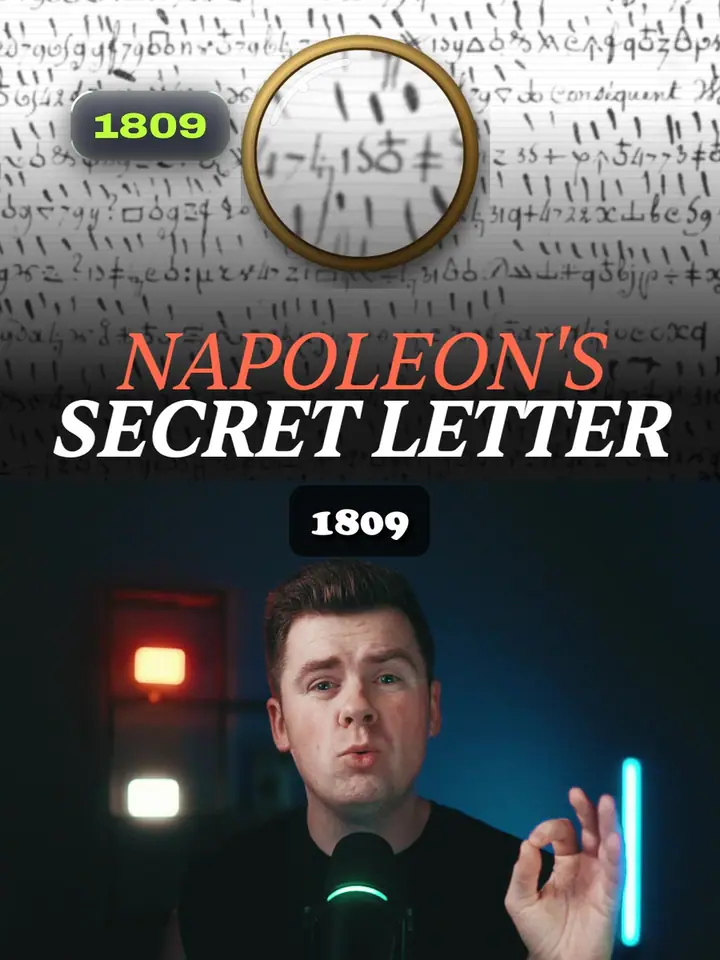
An engineer, Carter Church, gave GPT-6 Astra one scan of a printed page full of code signs. GPT-6 Astra is the newest AI from OpenAI, the company behind Chat GPT. After about 6 hours of work the code was open. It is a letter to Marshal Marmont from March 1809, and it says the Russians are marching against Austria.
Sources
28 caves in Ireland
The Lost Land Bridge Project used an AI tool to pick 28 caves in County Clare. In 8 of them the team found marks on the walls: finger lines, red ochre and shapes that may be animals. The marks are not dated yet, so "Ice Age" is only a maybe for now.
Source
A thousand pages of math notes
The mathematician is Kurt Gödel. A logician in Helsinki, Jan von Plato, typed out 1,009 pages of his shorthand notebooks by hand. Claude read the typed text and listed 663 possible math results. About 400 passed a proof checker.
Source
A Nazi radio message from 1941
The message was sent on 10 July 1941 and stayed unbroken on a code-breaking site for years. With GPT-6 Astra, an engineer built his own Enigma code machine in software and broke it. It says: "Please specify the route of march. I am in Rosenow. Immediate reply by radio." A very similar message, broken in 2017, helped.
Sources
Try it on your own old letter
Take a clear photo of an old handwritten letter and send it to Chat GPT with this prompt. We tested it on a letter Abraham Lincoln wrote in 1854.
Read an old letterRead the handwritten letter in this photo. 1. Type out exactly what it says, line by line. Keep the old spelling. 2. Put [?] after any word you are not sure about. Do not guess without telling me. 3. Then tell me in simple words: who wrote it, to whom, when, and what it is about. 4. If the letter is not in English, also translate it into English.
You did it
Now you know all four. Send this to a friend who loves history.